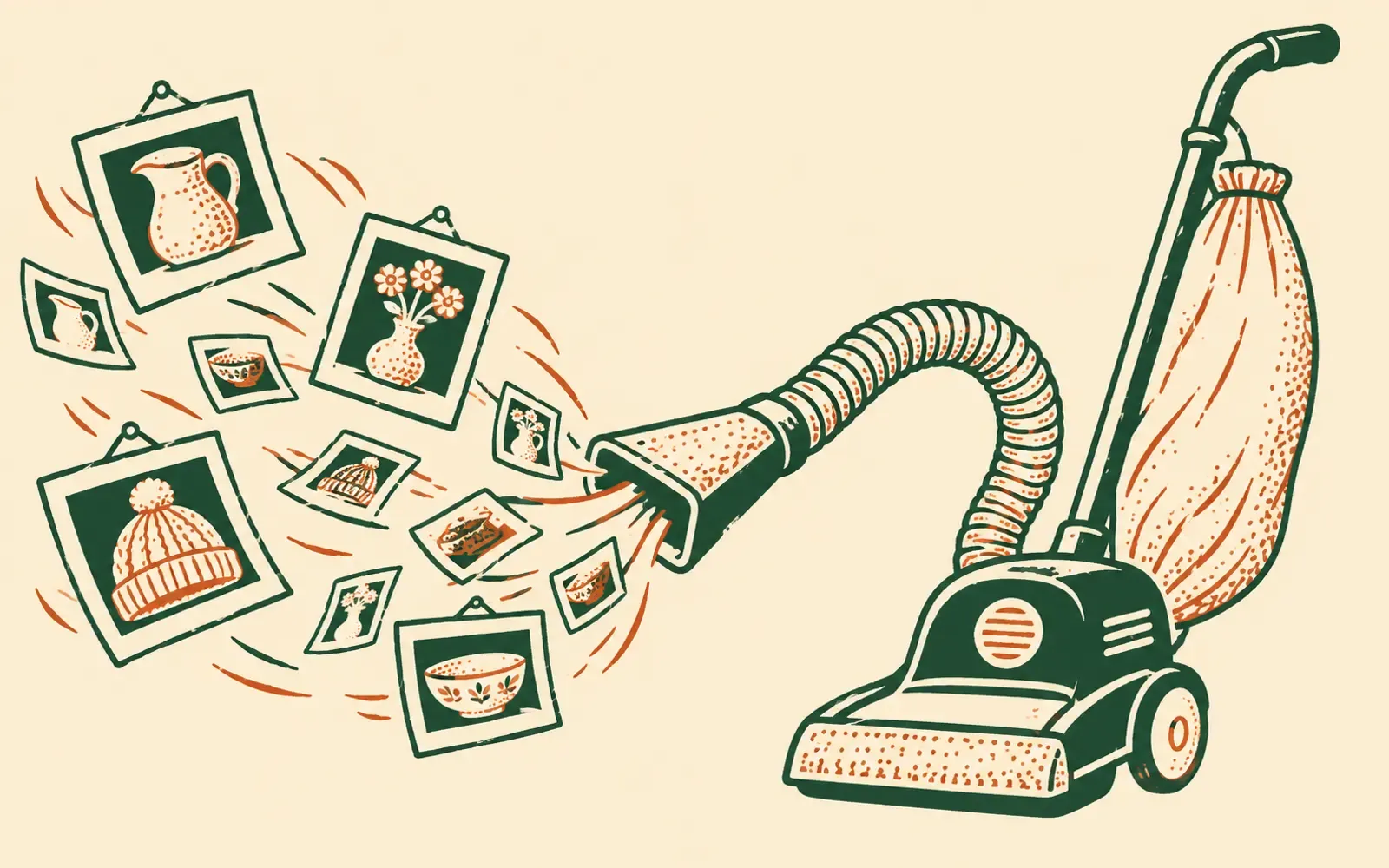
From 16 December 2026, Etsy and its partners may use your listing photos and descriptions to train AI. That is the change in Etsy’s new Terms of Use, published on 26 October 2026. There is no switch to turn it off. If you are in the UK or the EEA, you can ask Etsy to stop, and this page shows how.
Here is the short version, in Etsy’s own words, checked on 18 November 2026.
| What Etsy’s new terms say | |
|---|---|
| When it starts | 16 December 2026 |
| Who can train AI on your work | Etsy and its “third party partners and vendors”. The terms do not name them. |
| What it covers | Your listing photos, listing descriptions, reviews, videos and anything else you post |
| How long the licence lasts | “Perpetual” and “irrevocable” |
| Is there an opt-out switch? | No. UK and EEA sellers can object, and Etsy decides. |
| Do you still own your work? | Yes. Etsy says it does not claim ownership. |
This page is general information, not legal advice. It covers sellers in the United Kingdom first.
How Bernard helps
Etsy brings you buyers, and for many makers it is worth keeping. A website of your own sits beside your shop. On it, your rules apply, not a marketplace’s terms. Bernard’s own terms say: “We do not mine, resell, or train AI models on your site content.”
- Your name goes inside the file. When you say a photo is yours, Bernard writes your name and copyright line into the file itself, in the fields that cameras, editors and search engines read (your name stays with your photos).
- The hidden data comes out. Every new upload and import has its hidden location and device data removed before it goes on your site (What your photos say about you).
- You keep the proof. Bernard keeps an untouched private original of each new image, so you can show you had it first (prove I made this work).
- You make the AI choice. Your media library has a Protect your work panel. While its images switch is on, the photos you have said are yours carry a “not for AI training” note inside the file (can I stop AI companies training on my photos and video?).
- You can see who comes. The AI traffic report shows which AI companies’ crawlers visit your site and ask for your images (is AI reading my site?).
- Later: when the images switch is on, Bernard will tell AI training crawlers to stay out in your site’s robots.txt file, and then refuse the training crawlers that say who they are.
No website can stop a person or a dishonest crawler from copying a picture, and Bernard does not say it can. The reasons are in Can you stop AI companies training on your work?
What Etsy’s new terms say
Etsy calls everything you post “Your Content”. Section 5 of the Terms of Use lists what that covers: “shop names, profile pictures, listing photos, listing descriptions, reviews, comments, videos, usernames, etc.” Etsy says it does not claim ownership of any of it.
Section 5.C sets out the licence you give Etsy when you post. Three parts of it matter here.
- It covers AI training. The licence “includes the right for us and our third party partners and vendors to use Your Content to develop, train, test and improve artificial intelligence and machine learning technologies, including to improve the Services and/or help keep them safe, subject to any applicable opt-out rights described in our Privacy Policy.”
- It does not end. The licence is “non-exclusive, worldwide, royalty-free, irrevocable, sub-licensable, perpetual”.
- It reaches beyond Etsy. It covers Etsy’s “third party partners and vendors”. The terms do not name them.
The same section also asks you to agree “not to assert any moral rights or rights of publicity against us for using Your Content.”
What Etsy says it will use it for
Etsy’s privacy policy says it may use “listing information, product reviews, and community posts to train and develop artificial intelligence and machine learning models”. It gives a reason: “to offer you new features (like AI listing tools or AI review summaries).”
So the stated purpose is Etsy’s own tools. The terms do not say that Etsy will sell your photos to an AI company, and this page does not say so either. But the licence itself is wider than the examples, and it includes partners and vendors.
Etsy keeps other AI companies out
There is another side to this. Section 6.E of the new terms says no one may use content from Etsy “for the purpose of developing, training, fine-tuning, evaluating, benchmarking, testing, prompting, distilling, or otherwise contributing to any machine learning model, artificial intelligence system, or related technology, without our express permission.”
Some sellers read that as protection: outside AI companies are told to stay away from their listings. Both things are true at once. Etsy keeps the right to train on your work for itself and its partners, and it tells everyone else they may not.
Can you opt out?
Not with a switch. The licence says it is “subject to any applicable opt-out rights described in our Privacy Policy”. We read Etsy’s privacy policy, in its UK and US English copies, which say the same. Neither names a setting or a form that turns off AI training for your listings. Etsy’s help centre had no article on it when we searched on 18 November 2026.
What the policy does give is a right to object. Etsy lists its AI training under processing “where necessary for our legitimate interests”, and says: “In the EEA, UK, and other countries you have the right to object to, and seek the restriction of, this processing.”
Section 7 of the policy explains what happens when you object: “we will stop processing your information unless we have compelling legitimate grounds to continue processing or where it is needed for legal reasons.” So an objection is a request that Etsy weighs. It is not a switch.
How to object, step by step
Etsy’s privacy policy says you can use your rights “through the contact options set out in Section 12”. These are the steps, using only what the policy says.
- Choose how to send it. Section 12 lists Etsy’s Support team through the Help Center, chat support on the site, an email to Etsy’s Data Protection Officer at dpo@etsy.com, or a letter. From the UK or Europe the letter goes to Etsy Support Team, Privacy Policy, One Le Pole Square, Ship Street Great, Dublin 8, Ireland. Email leaves you a dated copy.
- Say who you are. Use the email address on your Etsy account, and give your shop name.
- Say what you object to. Keep it short. For example: “I object under Section 7 of your Privacy Policy to Etsy using the content I post, including my listing photos and descriptions, to train and develop artificial intelligence and machine learning models. Please confirm that you will stop, or tell me the grounds on which you say you can continue.”
- Keep the reply. Etsy says: “Once you contact us to exercise any of your rights, we will confirm receipt of your request.” Note the date you sent it.
- If you are not happy with the answer, the policy says UK residents may complain to the Information Commissioner’s Office (ico.org.uk).
An objection does not change the licence in the Terms of Use, which stays perpetual and irrevocable. It asks Etsy to stop one use of your content.
Sellers in the US. The objection right in the global policy is for “the EEA, UK, and other countries”. For US residents, Etsy points to its separate US Regional Privacy Notice for the rights some states give. We could not open that notice when we checked, so this page does not say what it allows.
Deleting a listing or closing your shop. The terms call the licence perpetual and irrevocable, and do not say what happens to it when you delete a listing. Section 7 says that closing your account “will not affect the availability of some of Your Content that you posted through the Services prior to termination.” Section 13 says that if you do not agree with changed terms, “you may close your account.”
What you can do
You do not have to leave Etsy to look after your work. These steps help wherever you sell.
- Send your objection before 16 December, if you are in the UK or the EEA and want to. The steps are above. Expect Etsy to weigh it.
- Keep your originals. Keep the full-size file straight from your camera or scanner, with its date. If a copy of your work turns up somewhere, it is the best proof you have (Someone copied my work. How do I prove it is mine?).
- Think about which images go on Etsy. A listing photo shows the product to a buyer. It does not have to be your best full-size file.
- Have a place of your own. A website sits beside your shop, not instead of it. Your photos there follow your rules, and buyers who find you on Etsy have somewhere to come back to.
- Look at the AI-free marketplaces with open eyes. Fybe (fybe.art) began its public push on 26 October 2026 as a marketplace for human-made work: generative AI is banned, sellers are vetted and there are no paid ads. It is the same trade as Etsy, their address, their rules and a fee on every sale (5% on its free plan, plus Stripe’s card fee), with far fewer buyers for now, and at the time of writing it cannot ship physical goods to the EU, EEA or Northern Ireland. A place of your own is still the one place where the rules are yours.
Wondering what other platforms say? Shopify, Squarespace and Wix are in Do Shopify, Squarespace and Wix train AI on your work?
A shop of your own, beside Etsy
Bernard is an AI-assisted website and marketing platform for small businesses. He builds a new site or moves an existing one, keeps it fast and readable to search and AI tools, and looks after it. Once measuring is on, he reads your numbers each week and suggests what to do next, with a button that does it. On the Nautilus Medium and Nautilus Large plans he also plans your marketing every six weeks and drafts your posts, emails and pages. Everything lands on a draft you approve. One flat price per site.
For an Etsy seller, that means a website with a shop, at your own address, for £200 a year. We bring your listings across for you, photos and prices included, and Bernard takes 0% of your sales. Your Etsy shop stays open and untouched (how a shop beside Etsy works).
See what Bernard would do with your business. Selling on Etsy? Tell us your shop and a person writes back within a working day with what your own site could look like and what it would cost. Nothing is built or charged until you say yes (tell us your Etsy shop). Already have a website? Paste its address and he measures it up, free, and shows you the new place before you decide anything.
Questions people ask
- When does Etsy’s AI training policy start?
- On 16 December 2026. Etsy published its new Terms of Use and Privacy Policy on 26 October 2026, and both take effect on 16 December 2026.
- Can Etsy train AI on my listing photos?
- Yes, from 16 December 2026. Section 5.C of Etsy’s new Terms of Use gives Etsy and its third party partners and vendors the right to use your content, including listing photos and descriptions, to develop, train, test and improve artificial intelligence and machine learning technologies. You still own your content.
- Can I opt out of Etsy using my listings for AI training?
- There is no switch. Etsy’s privacy policy names no setting or form that turns AI training off. In the UK, the EEA and some other countries you can object, by contacting Etsy’s Support team or emailing its Data Protection Officer at dpo@etsy.com. Etsy says it will stop unless it has compelling legitimate grounds to continue, so an objection is a request Etsy weighs. This is general information, not legal advice.
- Does deleting a listing or closing my shop end the licence?
- The terms do not say so. They describe the licence as perpetual and irrevocable. They say closing your account will not affect the availability of some of the content you posted, and they do not mention what happens to the licence when you delete a listing.
You might also want to read
- Can you stop AI companies training on your work?
- Etsy, Instagram or your own website: who decides what happens to your photos?
- Do Shopify, Squarespace and Wix train AI on your work?
- Someone copied my work. How do I prove it is mine?
- What your photos say about you
- Etsy fees explained for UK sellers, 2026
- The best website platform for artists: what Google tells you, and what it leaves out
- Where should a maker sell online? Etsy vs Shopify vs Ko-fi vs Big Cartel vs Bernard